Sometimes it’s one swing: the club catches the turf before the ball, and your elbow stings. Back pain can creep up more quietly. You felt fine at the turn, but by the 14th tee you’re shortening your backswing.

In a study that followed 910 amateur golfers for a season, lower-back injuries kept players off the course longer than any other injury. But the first thing an injury costs you isn’t always a round. Sometimes it’s the freedom to turn through a shot without thinking about what hurts.[1]
01 / The grip
When it hurts to hold the club
Where you feel it matters. Pain at the bony bump on the inside of your elbow, especially when you squeeze the grip or lift your bag, is typical of golfer’s elbow. Pain on the outside often involves the tendons that steady your wrist. That’s called tennis elbow, even when the club in your hand is a nine-iron.[2][7]
For persistent outside elbow pain, a trial of 52 people compared MLS laser therapy with shockwave therapy. Both groups did forearm and grip exercises and took anti-inflammatory medicine. Average pain scores fell 26% with MLS and 50% with shockwave. So while the laser group felt better, shockwave had the edge for this particular tendon problem.[4]
Back at the practice green, start with the smallest demand on your grip: a putt, then a few short chips. If picking up the coffee pot hurts again the next morning, hold off on a bucket of balls. Strengthening the forearm is what prepares it for gripping the club shot after shot.[7][12]
02 / The backswing
When a sore shoulder cuts your backswing short
You might first notice the shoulder at the top of your backswing, then again at home as you pull a shirt over your head. The rotator cuff helps lift and steady the arm in both movements.[10]
In a study of 47 people with persistent shoulder pain, patients who had MLS laser therapy and exercise averaged 34% greater improvement in pain and difficulty with everyday tasks than those who had electrical nerve stimulation, ultrasound and the same exercises. About two weeks after treatment ended, the average improvement was 45 points versus 34 on a 100-point scale.[6]
Here the laser addresses pain; the exercises help rebuild the motion and strength the swing asks of your shoulder. A short wedge shot gives you a way to try that motion before a full drive. Can you turn back and finish the shot comfortably, or are you still stopping short to protect the shoulder?[6][12]
03 / The back nine
When your back feels fine on the first tee but aches by the turn
One comfortable swing on the range tells you something. A string of swings, with a walk to the ball between each one, asks a different question: how long can you keep it up before the ache changes your turn?
For persistent low-back pain without a specific underlying cause, a randomized trial of 45 people found that average pain scores were 39% lower with MLS than with a simulated laser one month after eight treatment sessions.[5]
For a golfer whose back tires late in the round, treat the length of the outing as its own step. Try a few holes before committing to nine. If the shorter outing feels comfortable through the last swing and the next morning, add holes on a later visit. Pain that travels down a leg, especially with new weakness, calls for an assessment rather than another test round.[9][12]
04 / Back to the range
From the practice green to the first tee
Putting, chipping, short irons, then longer clubs: that’s the order used in the University of Arkansas for Medical Sciences’ return-to-golf program. Once you’re ready to practice again, warm up and change one thing at a time. If today is your first day hitting longer shots, it needn’t also be the day you double the number of balls.[8][12]
05 / Treatment explained
What happens during a robotic cold laser session?
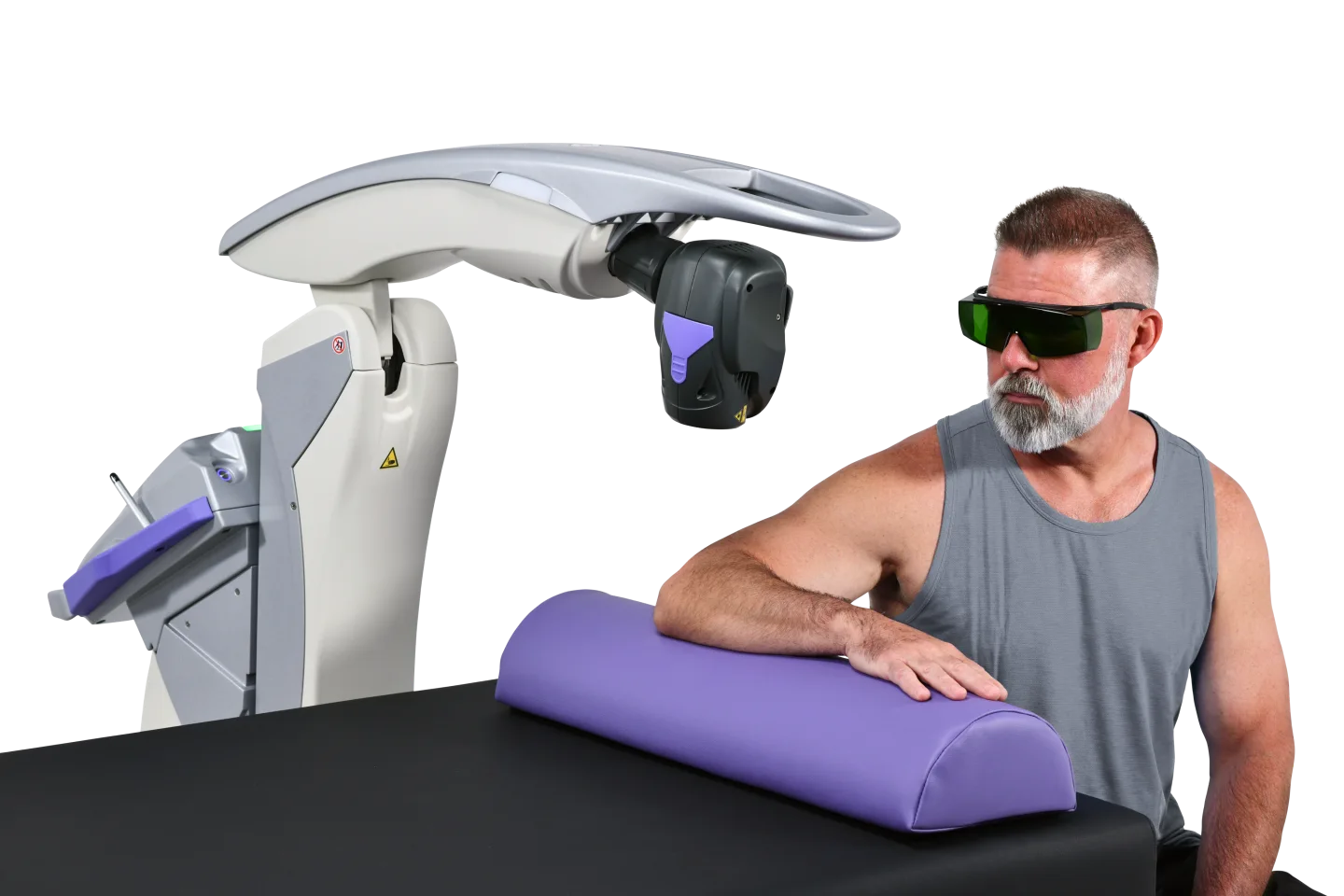
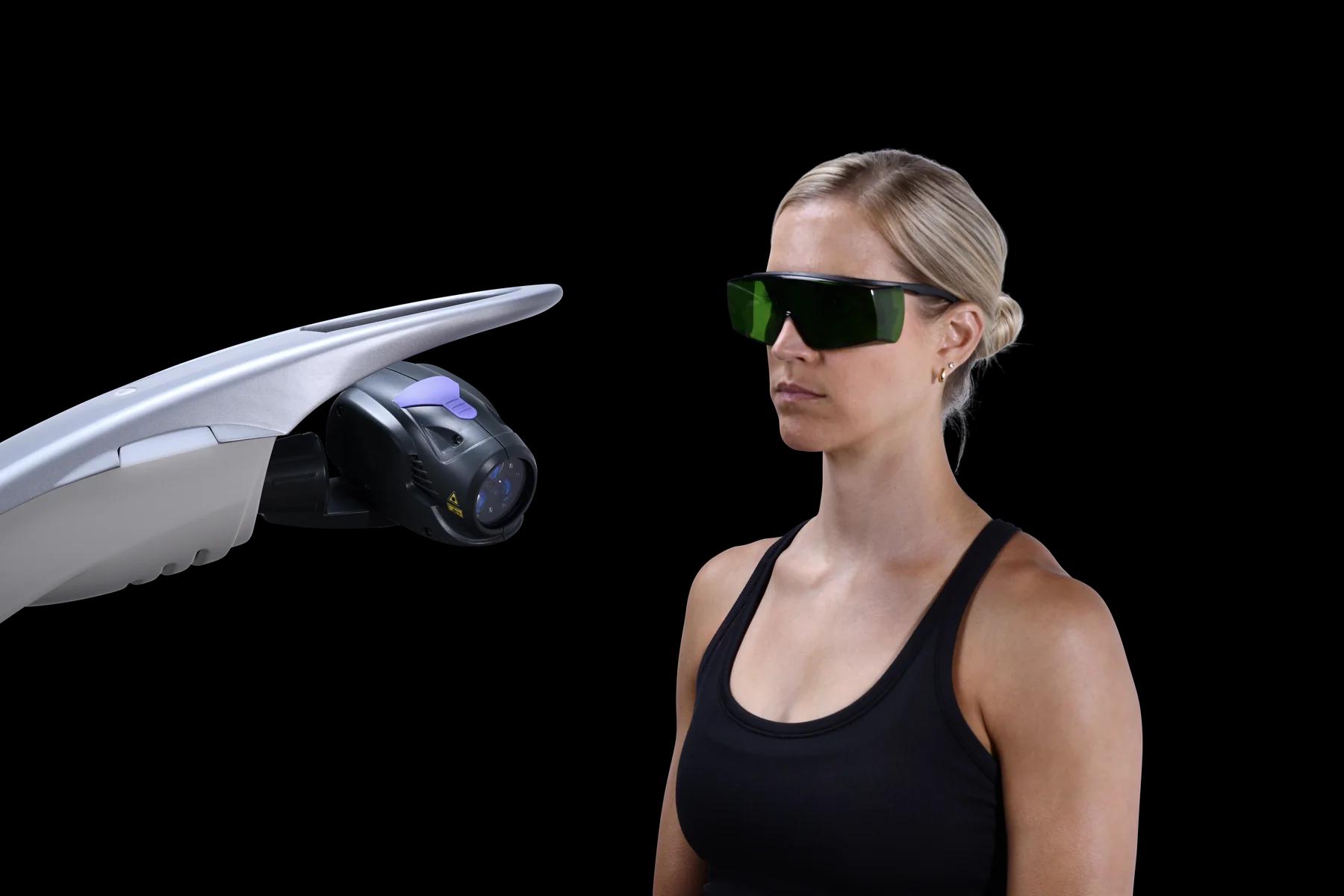
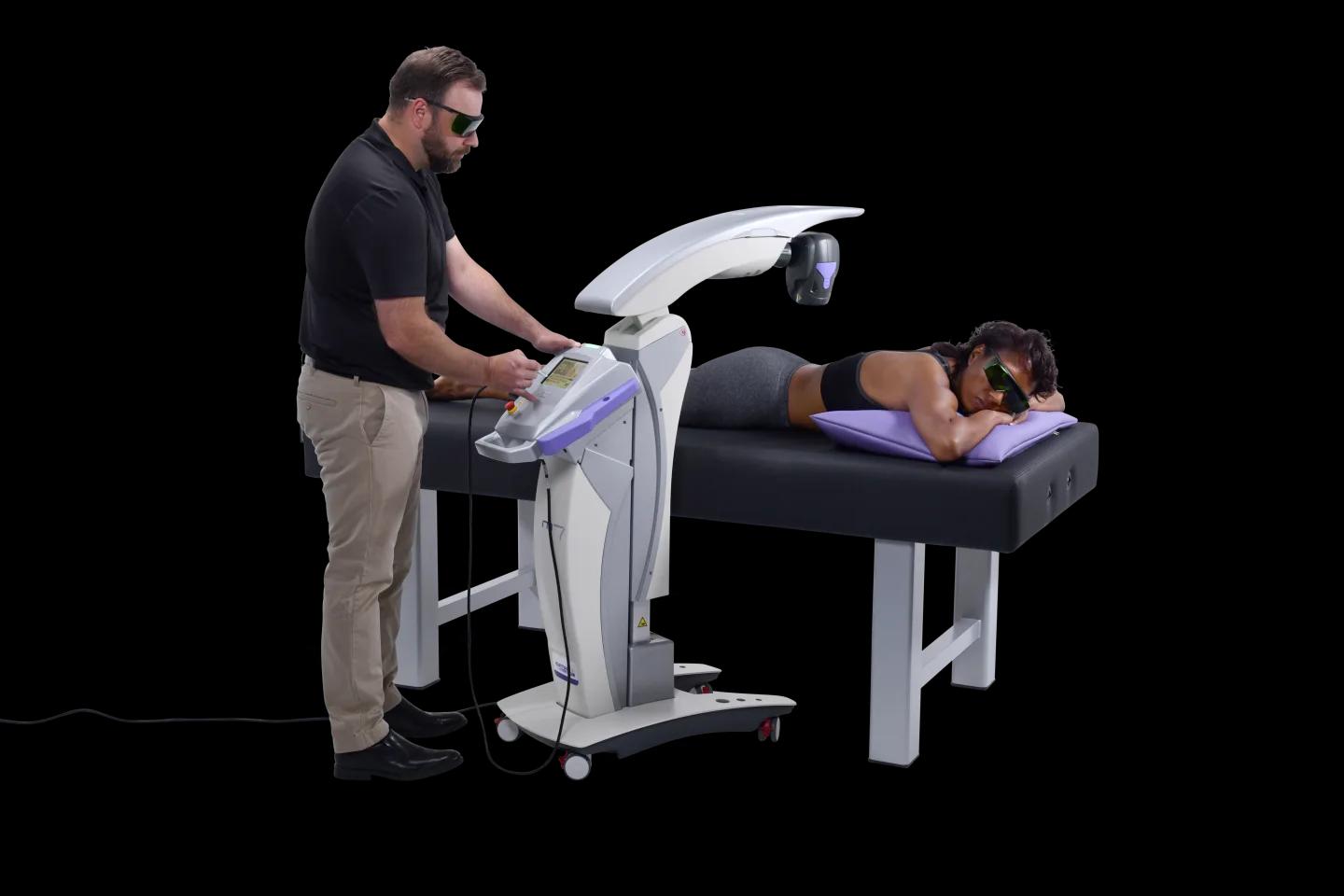
During robotic cold laser therapy, you wear protective glasses while a clinician positions the treatment head near the sore area. For a shoulder, the head scans the area without touching your skin. For a smaller spot, the clinician can use a handheld applicator.[3]
The robotic M7 MLS therapy laser combines two wavelengths of near-infrared light: 808 and 905 nanometers. The device sends them in sync, which is where the name Multiwave Locked System comes from.[3]
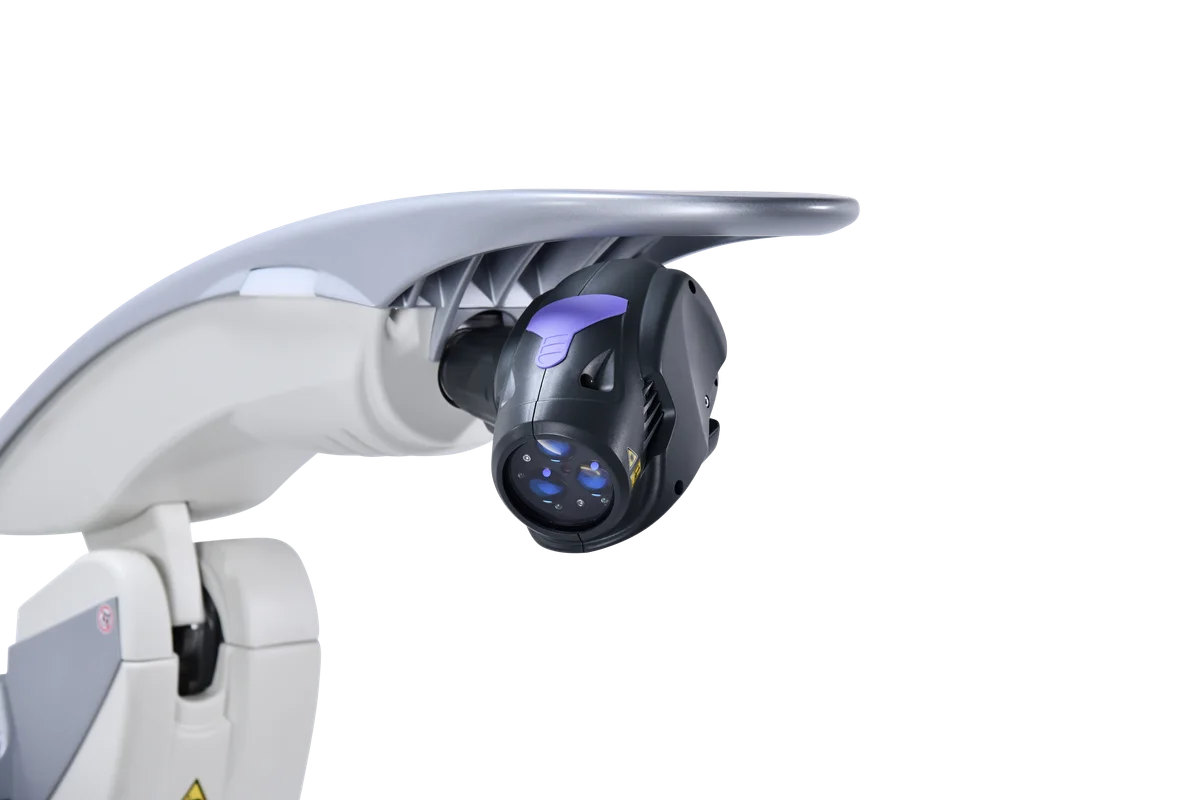
Robotic treatment head
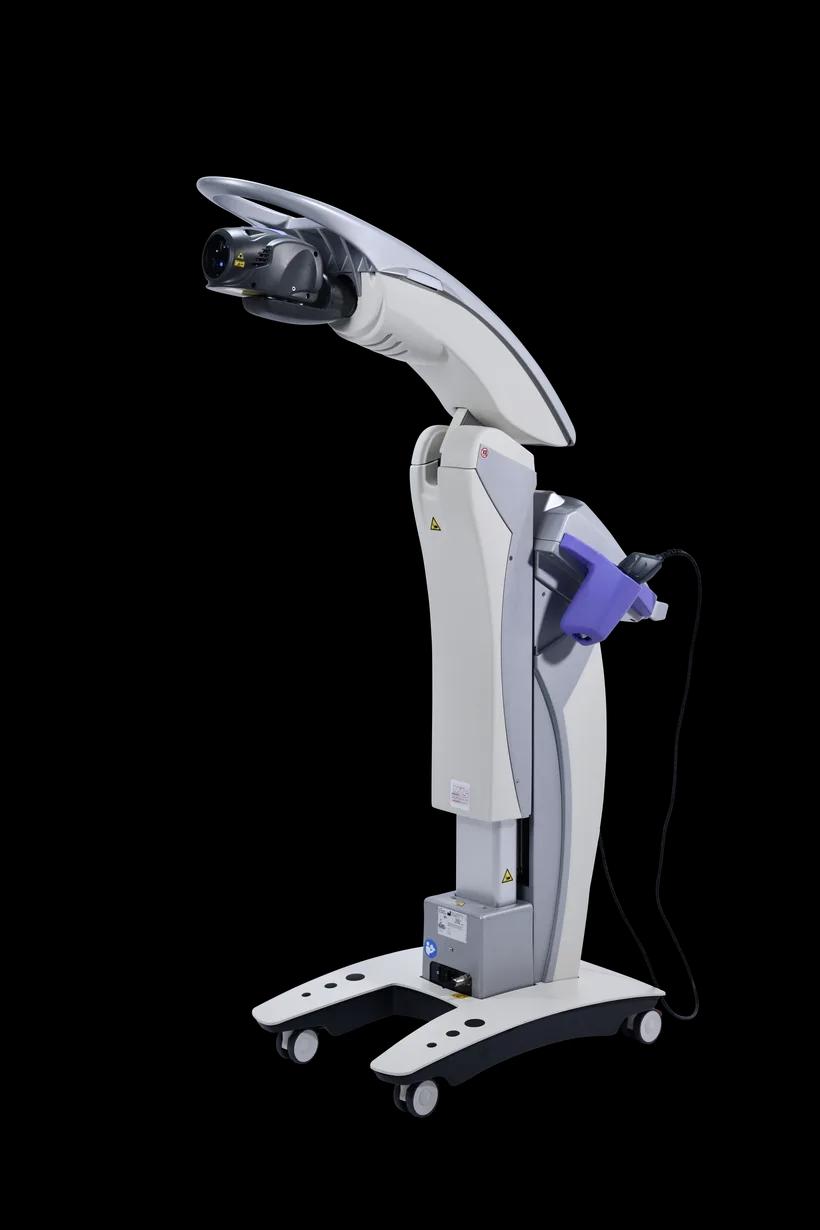
Full M7 system
06 / Getting care
When to get checked
If pain keeps changing your swing, get it examined. That includes a wrist that still hurts after catching the turf or a knee that hurts each time you pivot. A weaker grip or new numbness is worth mentioning even if you can still play. At a visit, expect to point out the sore spot, move the joint and have your strength checked. Those findings help your clinician decide whether exercises are enough or imaging or a specialist’s opinion would help.[2][7]
Seek prompt care for marked swelling or trouble moving a joint after an injury. Go to the emergency department for back pain with new trouble emptying your bladder, loss of bladder or bowel control, or numbness around your groin. Don’t wait for a routine appointment.[2][11]
Madalian Wellness in Wayne, New Jersey, offers both treatments: robotic cold laser therapy with the M7 MLS and radial shockwave therapy with the STORZ Medical D-ACTOR 100.
Research and guidance
Sources
- Robinson et al. A prospective study of injuries and illnesses among 910 amateur golfers during one season. BMJ Open Sport & Exercise Medicine, 2024.
- Mayo Clinic. Golfer’s elbow: symptoms and causes. See also the American Academy of Orthopaedic Surgeons’ guides to tennis elbow and golf injury prevention. Read the tennis elbow guide.
- Cutting Edge Laser Technologies. Robotic M7 MLS Therapy Laser. U.S. distributor’s description of the M7 and how it differs from the M6.
- Turgay et al. Comparison of low level laser therapy and extracorporeal shock wave in treatment of chronic lateral epicondylitis. Acta Orthopaedica et Traumatologica Turcica, 2020.
- Labanca et al. Effects of MLS laser on pain, function, and disability in chronic non-specific low back pain. Journal of Back and Musculoskeletal Rehabilitation, 2024. Double-blind, randomized trial. At one month the groups differed in pain scores, but not in forward-bending function or self-reported disability.
- The short-term outcomes of MLS laser therapy versus electrical nerve stimulation and ultrasound for subacromial pain syndrome. Applied Sciences, 2021. Nonrandomized comparison using the Mphi MLS laser. Table 2 reports changes on the Shoulder Pain and Disability Index.
- Lucado et al. Lateral elbow pain and muscle function impairments: Clinical practice guidelines. Journal of Orthopaedic & Sports Physical Therapy, 2022.
- American Academy of Orthopaedic Surgeons. Golf injury prevention. Warm-up, swing and injury-prevention guidance.
- Mayo Clinic. Back pain. Symptoms that should prompt an office visit or emergency care. See emergency warning signs.
- American Academy of Orthopaedic Surgeons. Rotator cuff tears. Shoulder symptoms, examination and imaging.
- American Association of Neurological Surgeons. Cauda equina syndrome. Emergency bladder, bowel and sensory warning signs.
- UAMS Orthopaedics. Golf progression. A graduated return to putting, chipping and longer clubs after injury.